
Issue S972 of 13 Oct. 1997
A slave girl is sold in Italy in 1248
Source: Robert S. Lopez & Irwin W. Raymond. Medieval Trade in the Meditteranean World. New York: Columbia Univ. Press, 1955, section III.44.
The slave trade was extensively practised in the Mediterranean Sea since Ancient times but it diminished after the 10th c. BCE when maintaining a slave became very expensive and when the number of slaves offered decreased. Definitely slaves in the 13th c were a luxury. This is a very interested contract between two Italians for the selling of a white slave girl who came from Malta but was most probably a muslim. Although this is a normal contract what strikes the reader is that the girl agrees to be sold a slave.
Genoa, May 11, 1248
I, Giunta, son of the late Bonaccorso of Florence, sell, give, and deliver to you, Raimondo Barbiere, a certain white slave of mine, called Maimona, formerly from Malta, for the price of (5 s.10 Genoese, which I acknowledge that I have received for her from you. . . . And I call myself fully paid and quit from you, waiving the exception that the money has not been counted and received. I acknowledge that I have given you power and physical dominion [over the slave], promising you that I shall not interfere nor take away the aforesaid slave in any way, but rather I shall protect [her] for you and keep her out [of the power] of any person (under penalty) of ( 20 Genoese which I promise you, making the stipulation, the promise remaining as settled. And I pledge for that. Waiving the privilege of [selecting] the tribunal. And I, said Maimona, acknowledge that I am a slave, and I wish to be delivered and sold to you, Raimondo. And I acknowledge that I am more than ten [years old]. Witnesses called: Oberto de Cerredo, notary, and Antonio of Piacenza, notary. Done in Genoa behind the Church of Saint Laurent, 1248, fifth indiction, on May 11, before terce.
Slaves in Byzantium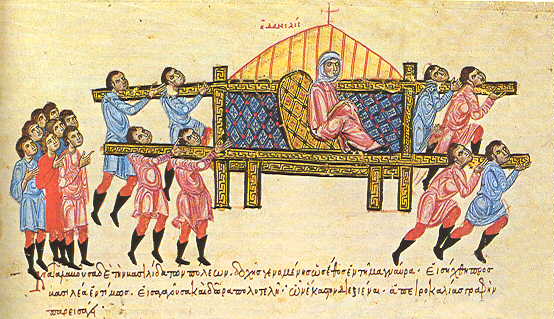 |
 Back to Cover
This page hosted by
 Get your own Free Home Page