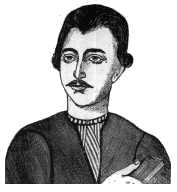
Emmanouil Xanthos died poor because of an accident in 1852. He was buried receiving honors equivalent to a general of the Greek army.
Xanthos narrates the founding of the Philiki Etaireia in his book The Philiki Etareia (in Greek)
[Xanthos writes in the third person]:
[translated by D. I. Loizos]
[...] Then he [Xanthos] went to Agia Mavra [Leukada] and he was induced by one of his friends by the name Panayiotakis Karayiannis to enter the Free Masons Society. Because he was inspired by the idea of freedom and hated the Turkish tyranny he immediately conceived the idea that a secret society could be formed with similar principles as those of the free masons. The goal of the society would be to bring together all the military leaders (kapitanioi armatoloi) and all other Greek officials of any class who lived either in Greece or elsewhere. They would take immediate steps, as occasion offered, toward the liberation of the Homeland.
After finishing his business in those places Xanthos returned to Odessa in early November 1813 and made friends with Nikolaos Skoufas from Arta and Athanasios N. Tsakalof from Yiannina [...] who happened to be there and where young men full of patriotic and liberal sentiments. In one of their friendly meetings in 1814 those three friends discussing the horrible condition and the tyranny the Greeks suffered in Turkey and especially in Peloponnisos, Ipiros and some islands and deploring the hard fortunes of the nation, they blamed the Christian Kings in the Conference of Vienna for the indifference they had shown after the fall and exile of Napoleon in Elba. Nevertheless, one of the wise men in Vienna published a treatise in a pamphlet form advising the allied Kings to send their already united and victorious army beyond the Danube to liberate an old glorious nation, the Hellenic (Greek), which has been enslaved for centuries by a barbarious and incapable of being a civilized nation, the Turks, etc. But the Austrian government was informed about the pamphlet by their ambassador in the Ottoman Sublime Porte, Mavrogenis, and prevented [the spread of the idea] and seized the pamphlet saying that there is no Hellenic nation recorded in the archives of the nations, and the like.
Then Xanthos grasped the opportunity to tell his friends about the idea he had conceived for the formation of a society that would have as its only goal the liberation of Homeland. Ge also revealed to them that he was a member of the Masonic Society and he explained some of its principles, those that could be used in the new one. After he had explained the above he asked them to consider the character of the Greek people and the sources of their strength, the political and moral condition of their oppressors, the Turks, the arguments of Rhigas from Thessaly [for a revolution], the victories of the brave Souliotes, the people of Parga and various other warriors (armatoloi) called by mistake kleftes (bandits) who fought against Ali Pasha of Yannina, the occasional victories of our seamen at sea against Lambros Katsonis, the general heatred of the Greeks against the tyrants, the Turks.
Thus the friends decided to attempt the formation of that society and initiate all the best and bravest of the Greeks to achieve by themselves what in vain and for a long time they hoped to have been achieved by the philanthropy of the Christian Kings [of Europe]. [...]
 Back to Cover
This page hosted by
 Get your own Free Home Page